
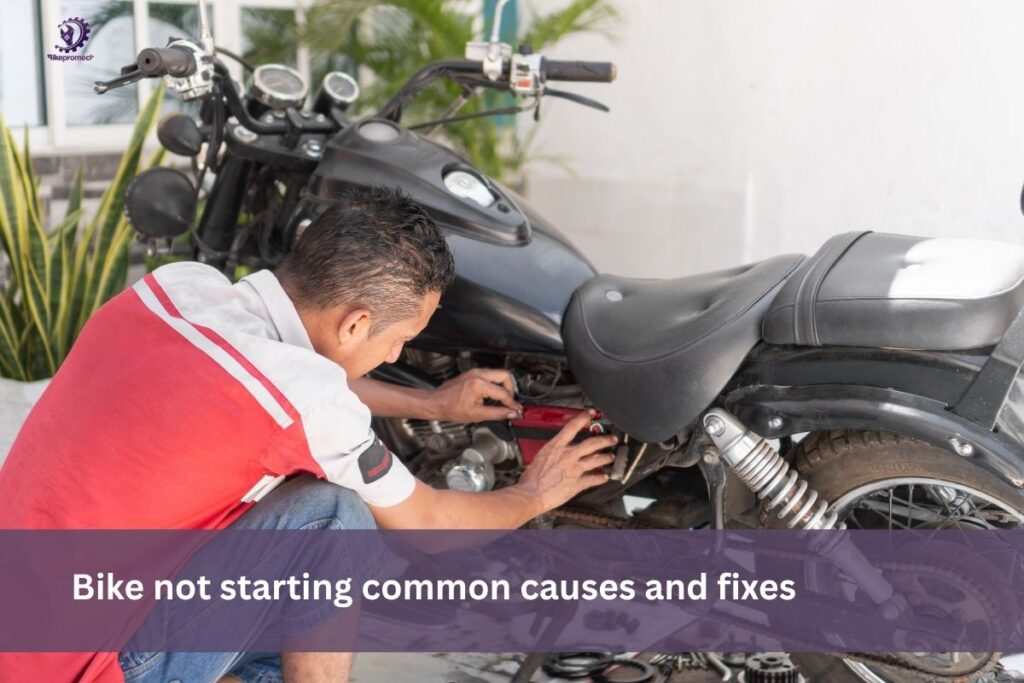
A bike that won’t start is most commonly caused by one of four things: a weak or dead battery, an empty or stale fuel supply, a fouled spark plug, or a safety interlock (like the side-stand switch) preventing the engine from cranking. Roughly 60–70% of no-start complaints trace back to the battery or fuel system, both of which you can often check yourself in under five minutes.
This guide walks through each likely cause in order of how common it is, how to tell which one you’re dealing with, and what fixes it — plus what to check before you assume the worst.
Quick Diagnostic: What Your Bike Is Telling You
Before going through the full list, the way your bike fails to start narrows things down fast:
| What Happens When You Try to Start | Likely Cause |
| Nothing at all — no lights, no sound | Dead battery, blown fuse, or loose battery terminal |
| Self-start motor cranks slowly or clicks, but engine doesn’t fire | Weak battery, or battery can’t deliver enough current |
| Self-start cranks normally, engine doesn’t catch | Fuel or spark issue |
| Engine cranks and almost starts, then dies | Fuel delivery or air-fuel mixture issue |
| Dashboard lights on, but self-start does nothing | Side-stand switch, clutch safety switch, or start relay issue |
| Bike started fine yesterday, dead today with no riding in between | Battery drain — parasitic draw or a bike left unused too long |
1. Battery Issues (Most Common Cause)
How to Tell
Dim or no dashboard lights, a slow or clicking crank, or a self-start that does nothing at all are the clearest signs. A healthy 12V bike battery should read about 12.4V or higher at rest, and shouldn’t drop dramatically under cranking load.
Common Causes
- Battery has aged past its useful life (typically 2–3 years for a standard lead-acid or MF battery)
- Loose or corroded battery terminals interrupting the connection
- Bike left unused for weeks, allowing the battery to self-discharge
- A parasitic draw — something (like an aftermarket accessory) drawing power even with the bike off
Fix
- Clean and tighten terminals if corrosion or looseness is visible
- Jump-start or charge the battery to test if it’s simply discharged rather than dead
- Replace the battery if it’s aged past 2–3 years or won’t hold a charge after a full charge cycle
- If the battery drains repeatedly within days of a fresh charge, have the charging system and any aftermarket wiring checked, since that points to a draw or charging fault rather than the battery itself
Also read – How to know if my bike needs an oil change
2. Fuel System Issues
How to Tell
The bike cranks normally (so it’s not a battery or electrical issue) but doesn’t fire, or fires briefly and dies.
Common Causes
- Empty or near-empty fuel tank (check the actual float level, not just the gauge, since fuel gauges can be inaccurate)
- Stale fuel after weeks of being parked — petrol degrades and can gum up injectors or the carburetor
- Clogged fuel filter or fuel line restricting flow
- Carburetor float stuck or flooded, especially after the bike has tipped over or sat at an angle
- Fuel injector blockage on FI bikes, though this is less common than carburetor issues on older bikes
Fix
- Confirm there’s actually fuel in the tank
- If the bike has been idle for over a month, drain old fuel and refill with fresh petrol
- For carbureted bikes, check if the float bowl is flooded (a strong fuel smell around the carb is a giveaway) — in that case, hold the throttle open while cranking to clear excess fuel
- If fuel delivery still seems restricted, a mechanic can check the fuel filter and lines, or the injector on FI bikes
3. Spark Plug and Ignition Issues
How to Tell
The bike cranks and turns over but there’s no “catch” at all, and you can sometimes smell unburnt fuel — a sign fuel is reaching the engine but not igniting.
Common Causes
- Spark plug fouled with carbon deposits or oil, especially if it’s overdue for cleaning/replacement (typically every 10,000–15,000 km)
- Spark plug gap incorrect, disrupting a clean spark
- Damaged or disconnected spark plug cap or ignition coil wiring
- Moisture around the spark plug or ignition components, common after riding through water or heavy rain
Fix
- Remove and inspect the spark plug — clean carbon deposits, check the gap against spec, and replace if it looks worn, oily, or cracked
- Dry off the plug and surrounding area if moisture is the suspected cause
- If a new, correctly-gapped spark plug still doesn’t produce a visible spark when tested, the ignition coil or CDI unit likely needs inspection
4. Safety Switch and Interlock Issues
Modern bikes have built-in safety interlocks that prevent starting under certain conditions — these are often mistaken for a “dead bike” when they’re actually working as designed.
Common Culprits
- Side-stand switch: Many bikes won’t start (or will stall) if the side stand is down, even in neutral, depending on the model.
- Clutch safety switch: Some bikes require the clutch lever to be pulled in before the self-start will engage, especially in gear.
- Neutral/gear position sensor: If the bike thinks it’s in gear without the clutch pulled, the starter circuit may be blocked.
Fix
- Retract the side stand fully before attempting to start
- Pull the clutch lever in while pressing the start button, even in neutral, as a first troubleshooting step
- If the bike still won’t start with these positions correct, the switch or sensor itself may be faulty or misaligned and needs inspection
Also read – Best bike insurance plans in India
5. Electrical and Fuse Issues
How to Tell
Total electrical silence — no dashboard lights, no horn, nothing — often points here rather than just the battery, especially if the battery has tested fine.
Common Causes
- Blown main fuse, often from a short circuit or a recent electrical accessory installation
- Corroded or loose wiring connectors, particularly after monsoon exposure
- Faulty ignition switch or key not making proper contact
Fix
- Check the fuse box (location varies by model, usually near the battery) for a blown fuse and replace with the correct amperage rating
- Inspect visible wiring connectors for corrosion, especially if the bike has recently been through flooding or heavy rain
- If the ignition switch itself seems unresponsive or the key turns without any electrical response, it may need replacement rather than repair
6. Compression and Mechanical Issues (Less Common, More Serious)
How to Tell
The bike cranks unusually easily (little resistance), or the kickstart feels abnormally light, with no attempt to fire at all.
Common Causes
- Worn piston rings or cylinder, causing loss of compression
- Valve clearance issues preventing proper compression
- A more significant internal engine problem
Fix
This category generally isn’t a DIY fix — if you suspect low compression (the engine feels “too easy” to crank, unlike a normal battery or fuel issue), it needs a proper engine diagnostic rather than repeated attempts to start it, since continued cranking won’t resolve a mechanical issue and may add unnecessary wear.
Monsoon and Weather-Related No-Start Issues
Bikes in India see a spike in no-start complaints during monsoon season, for a few specific reasons:
- Water in the spark plug well or ignition components after riding through waterlogged streets
- Corroded electrical connectors from repeated moisture exposure over the season
- Water-contaminated fuel if the bike has been parked in flooded areas
- Battery terminal corrosion accelerated by humidity
If your bike stalls immediately after riding through deep water and won’t restart, avoid repeated cranking attempts — this can push water further into the engine or electrical system. It’s safer to have it checked before restarting rather than risk hydrolock (water entering the combustion chamber) or a wiring short.
BikeProMech: One Bike, Every City, One Trusted Mechanic
Your bike doesn’t care what city it’s in — but the fixes it needs often do. Monsoon rust in Coimbatore isn’t the same problem as heat-cracked engine oil in Hyderabad or stop-start traffic wear in Bangalore. That’s exactly why BikeProMech built doorstep service that adapts to where you actually ride.
Wherever You Are, We’re Already There
If you’re riding through Bangalore’s daily gridlock, your bike is doing double the work your engine oil is rated for — start with our Bangalore bike service page to see real-time slots near you, or read up on choosing the right engine oil for stop-start traffic before you book.
In Hyderabad, summer heat is brutal on batteries and coolant systems alike. Check our Hyderabad doorstep service page for local mechanics, and if your bike’s been sluggish to start lately, our bike battery health DIY guide will tell you in five minutes whether it’s a battery issue or something bigger.
And if you’re in Coimbatore, where monsoon spells mean tyre grip and rust prevention matter more than anywhere else, our Coimbatore service page connects you to mechanics who know the terrain — pair that with our complete 25-point service checklist so nothing gets missed before the rains hit.
Not Just a City Match — The Right Fix, Every Time
Whichever city you’re in, the service you need is one click away:
- Overdue for a checkup? → Periodic Bike Service
- Engine running rough? → Engine Repair
- Battery dying without warning? → Bike Battery Replacement
- Bald tyres before a long ride? → Tyres at Home
- Post-accident dents and repairs? → Accidental Repair
- Stranded on the road right now? → Roadside Assistance
Book Once, Ride Worry-Free All Year
Skip the one-off bookings entirely our Membership/AMC plans bundle periodic service, priority RSA, and battery checks into one flat annual cost, no matter which of our 20+ cities you’re riding in. Add bike insurance on top, and you’ve covered every failure point your bike could throw at you, mechanical or otherwise.
Ready to stop guessing and start booking? Find your city, book your mechanic, and get back on the road in under an hour.
A Simple Step-by-Step Troubleshooting Order
- Check the dashboard lights — if nothing lights up, suspect the battery or fuse first.
- Try the kickstart (if your bike has one) — if it starts on kick but not self-start, the issue is likely the battery or starter motor, not the engine itself.
- Check the side stand and clutch position — retract the stand, pull the clutch in, try again.
- Check fuel level — confirm visually if possible, not just by gauge.
- Listen and smell — a strong fuel smell suggests flooding; no smell at all with normal cranking suggests a fuel delivery or spark issue.
- If it cranks but won’t fire, check the spark plug next.
- If none of the above resolves it, it’s time for a proper diagnostic rather than continued guesswork — repeated cranking on a low battery can drain it further, and repeated cranking on a flooded engine can cause additional issues.
Also read – Best Engine Oil for Bikes
Stuck With a Bike That Won’t Start Right Now?
If you’re stranded and need help on the spot, BikeProMech’s roadside assistance (RSA) service sends a mechanic to your location to diagnose and fix common no-start issues on-site, including battery jump-starts, fuel checks, and spark plug replacement. If the cause turns out to be the battery itself, our battery replacement service can swap it in the same visit. For anything that turns out to be mechanical, our engine repair service takes it from there. Book a doorstep visit for ₹199, with pricing confirmed before any work begins.
Frequently Asked Questions
This pattern usually points to a battery issue — either it’s aged and finally failed, or something drew power overnight (a parasitic draw, a light left on, or an aftermarket accessory). It’s less likely to be a fuel or spark issue if nothing else changed.
Yes — batteries age regardless of use, typically lasting 2–3 years, and a battery near the end of its life can fail suddenly even with regular riding, especially after a cold night or a short trip that doesn’t fully recharge it.
Not indefinitely. Repeated cranking on a weak battery drains it further, and repeated attempts on a flooded carburetor or a mechanical issue won’t fix the underlying cause. If it doesn’t start within a few attempts, it’s better to diagnose the cause than keep trying.
Avoid repeated starting attempts. Water in the spark plug well, air intake, or electrical connectors needs to be identified and dried out or cleared before restarting, since continued cranking risks pushing water further into the engine.
No — a good battery is necessary but not sufficient. Fuel delivery, spark, and mechanical compression all need to be functioning too, so a charged battery with a fouled spark plug or empty tank still won’t start the bike.