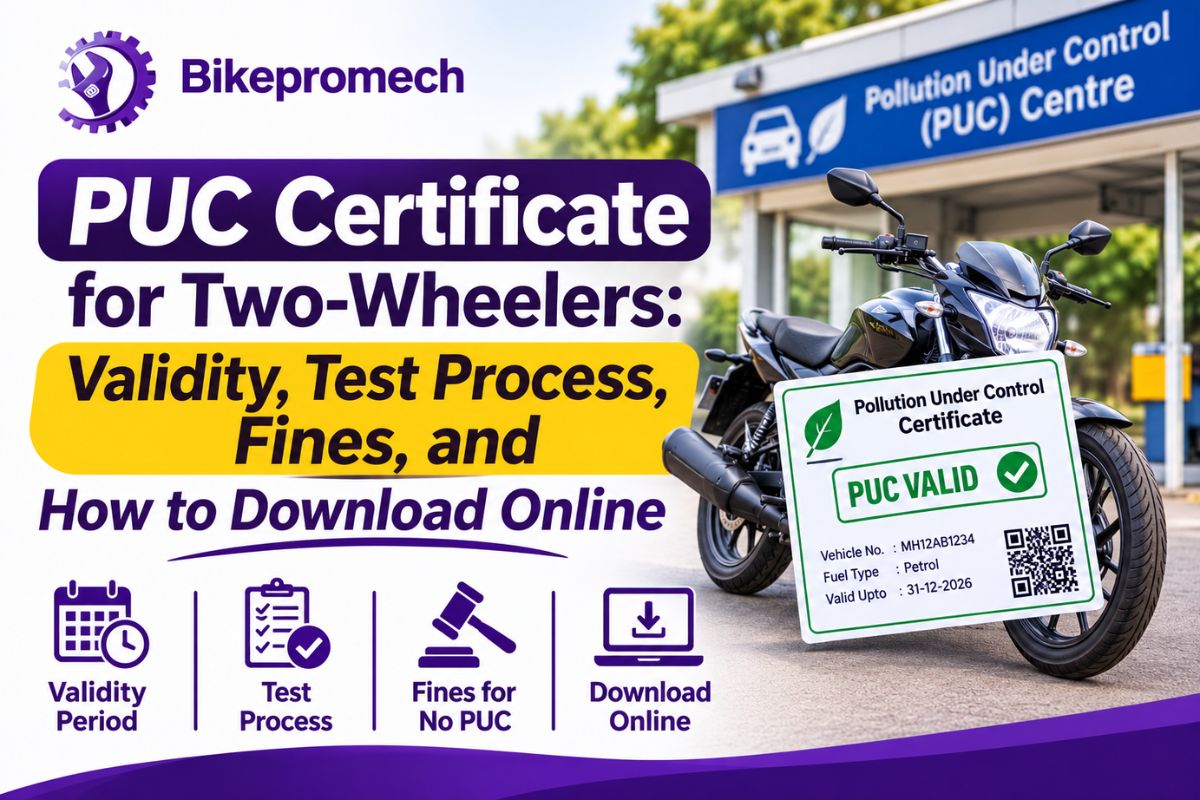


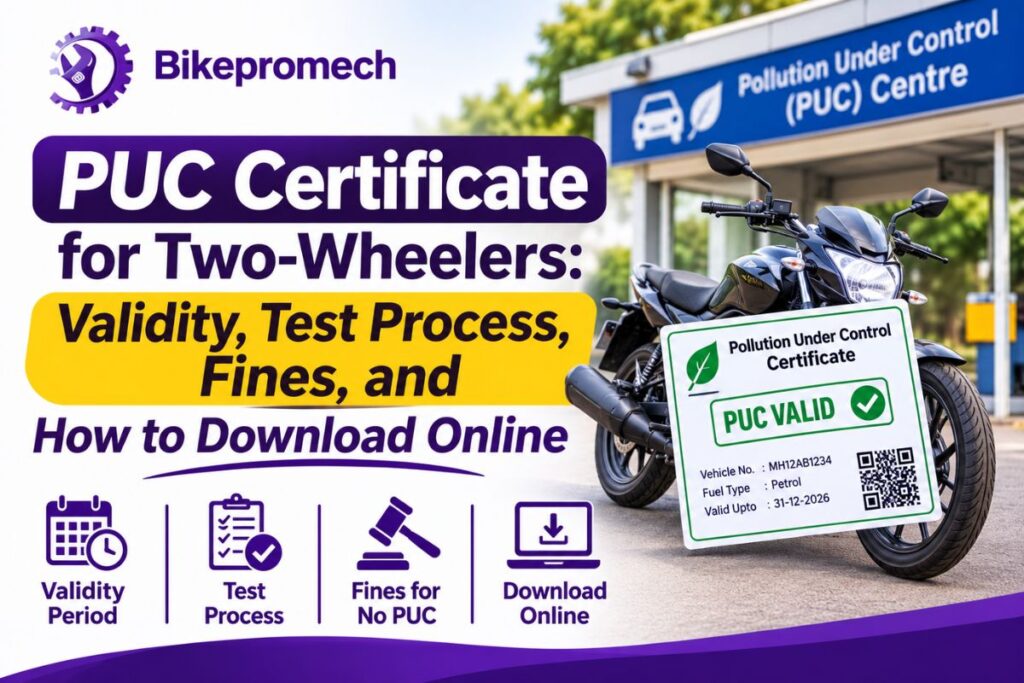
PUC Certificate for Two-Wheelers: A PUC (Pollution Under Control) certificate is a mandatory document for every petrol two-wheeler in India that proves your bike’s exhaust emissions are within legal limits. A new bike’s first PUC is valid for 1 year from registration; after that, each renewal is typically valid for 6 months, the test costs around ₹60–₹100, and you can download the certificate anytime from puc.parivahan.gov.in using your registration number and the last 5 characters of your chassis number.
Electric two-wheelers do not need a PUC certificate.
Quick Facts: PUC Certificate for Bikes and Scooters
| Detail | What You Need to Know |
| Full form | Pollution Under Control Certificate (PUCC) |
| Who needs it | All petrol two-wheelers (bikes and scooters) |
| Who is exempt | Electric two-wheelers |
| First validity (new bike) | 1 year from the date of registration |
| Renewal validity | Usually 6 months (can vary by state and emission norm) |
| Test cost | Approximately ₹60–₹100 for two-wheelers |
| Test time | 5–10 minutes |
| Where to get it | Authorised PUC centres, usually at petrol pumps |
| Official portal | puc.parivahan.gov.in |
| Needed for insurance | Yes — insurers can ask for a valid PUC at renewal |
What Is a PUC Certificate for Two-Wheelers?
A PUC certificate for two-wheelers is an official document issued after an emission test that confirms a bike or scooter’s carbon monoxide (CO) and hydrocarbon (HC) output is within the limits set under the Central Motor Vehicles Rules, 1989. It is one of the four documents every Indian rider must carry (physically or digitally), along with the driving licence, the two-wheeler RC book, and a valid bike insurance policy.
What details are printed on a bike PUC certificate?
A two-wheeler PUC certificate contains:
- Certificate serial number — a unique ID linked to the national VAHAN database.
- Vehicle registration number — the number on your number plate.
- Date of test and time of test.
- Validity / expiry date — the date by which you must renew.
- Emission readings — measured CO (%) and HC (ppm) values.
- Fuel type and emission norm — e.g., Petrol, BS-IV or BS-VI.
- Photo of the vehicle’s number plate taken at the centre.
- PUC centre code and name.
What Is the Validity of a PUC Certificate for Bikes?
The validity of a PUC certificate for a two-wheeler depends on whether the bike is new or already registered and on the emission norm it follows.
| Vehicle Condition | PUC Validity |
| Brand-new two-wheeler (first certificate issued with the vehicle) | 1 year from registration |
| BS-VI two-wheeler after the first year | 6 months to 1 year, depending on state and PUC centre |
| BS-IV and older two-wheelers after the first year | 6 months |
| Older BS-I to BS-III vehicles | Some states require shorter intervals (as low as 3 months) |
| Electric two-wheeler | Not required |
Is the PUC validity rule changing in 2026?
In July 2026, the Ministry of Road Transport and Highways (MoRTH) published a draft proposal to extend PUC validity for BS-VI private vehicles up to 6 years old from 1 year to 3 years. Under the same draft, BS-IV vehicles would renew every 6 months and BS-I to BS-III vehicles every 3 months. This is a draft proposal, not a final rule — until a final notification is issued, follow the expiry date printed on your current certificate.
Practical tip: The validity printed on your certificate is the only date that matters legally. If a PUC centre issues a 6-month certificate for a BS-VI bike, that 6-month date is what traffic police and insurers will check.
How Does the PUC Test Work for Two-Wheelers? (Step-by-Step)
The PUC test for a two-wheeler is a 5–10 minute exhaust gas check done at an authorised centre with a computerised gas analyser connected to the VAHAN system.
- Ride to an authorised PUC centre. Most are located at petrol pumps; look for the “PUC Centre” board with the centre’s authorisation code.
- Warm up the engine. Ride at least 10–15 minutes before reaching the centre. A cold engine produces higher CO and HC readings and can fail the test.
- Share your registration number. The operator enters it into the system, which pulls your vehicle details from VAHAN.
- Number plate photo is taken. The software captures a photo of your bike’s rear number plate as proof of the test.
- Probe is inserted into the silencer. The operator places the gas analyser probe 5–8 inches inside the exhaust pipe.
- Idle-speed reading is recorded. The bike runs at idle while the analyser measures CO (%) and HC (ppm).
- Result is generated. If readings are within limits, the certificate is printed and automatically uploaded to the Parivahan PUC portal.
- Pay the fee. Pay ₹60–₹100 in cash or via UPI and keep the printed slip.
Also read – Royal Enfield Hunter 350 & Classic 350 Service Schedule and Cost Breakdown
What are the emission limits for petrol two-wheelers?
Under Rule 115 of the Central Motor Vehicles Rules, petrol two-wheelers manufactured after 31 March 2000 must show idle CO at or below 3.5% and, for 4-stroke engines, HC at or below 4,500 ppm. Most well-maintained BS-IV and BS-VI bikes read far below these limits.
Why Does a Bike Fail the PUC Test?
A two-wheeler usually fails a PUC test because of a fuel-air mixture problem or a worn engine component that causes incomplete combustion. The most common causes are:
- Old or degraded engine oil — burnt or thinned oil increases HC readings. Read how to know if your bike needs an oil change and choose the right grade from this guide to the best engine oil for bikes.
- Clogged air filter — restricts airflow and makes the mixture rich, pushing CO above 3.5%.
- Dirty or faulty spark plug — causes misfires and unburnt fuel in the exhaust.
- Dirty throttle body or carburettor — disturbs the air-fuel ratio. Understand the role of this part in why a throttle body is used in a motorcycle engine.
- Worn piston rings or valve seals — allow oil to burn inside the combustion chamber, visible as blue or white smoke. Major internal wear is covered in this breakdown of bike engine repair cost in India.
- Weak battery on fuel-injected bikes — low voltage can affect injector and sensor performance. Use this DIY bike battery health check guide.
- Overdue servicing — a bike that has skipped 2–3 services almost always shows higher emission readings.
What should you do if your bike fails the PUC test?
If a two-wheeler fails the PUC test, the centre issues a Rejection Slip that records the failed readings. You must get the bike serviced and retest it. A basic service — oil change, air filter cleaning, spark plug check and carburettor or throttle body cleaning — fixes most failures. See what a basic two-wheeler service includes before your retest.
What Is the Fine for Riding Without a Valid PUC Certificate?
Riding a two-wheeler without a valid PUC certificate is an offence under Section 190(2) of the Motor Vehicles Act, 1988 (as amended in 2019).
| Penalty Type | Amount / Action |
| Maximum fine under Section 190(2), MV Act | Up to ₹10,000 |
| Possible imprisonment | Up to 3 months (or fine, or both) |
| Licence action | Driving licence can be disqualified for 3 months |
| Commonly collected challan in many states | ₹1,000 first offence; ₹2,000 repeat offence (varies by state) |
Important: States set their own compoundable challan amounts, so the amount collected on the road can differ from the maximum in the Act. Delhi, Maharashtra and Karnataka run periodic PUC enforcement drives, especially in winter when air pollution peaks.
Does an expired PUC affect bike insurance?
Yes. A valid PUC certificate is commonly requested when you buy or renew a two-wheeler policy, and an expired PUC can create complications during a claim. Compare cover options in this guide to the best bike insurance plans in India and this list of bike insurance companies in India.
How to Download a PUC Certificate Online (Step-by-Step)
You can download a two-wheeler PUC certificate online for free from the Parivahan PUC portal, as long as the test has already been done at an authorised centre.
- Open the official portal: Go to puc.parivahan.gov.in/puc.
- Select “PUC Certificate” from the menu on the homepage.
- Enter your vehicle registration number (e.g., KA01AB1234 — no spaces).
- Enter the last 5 characters of your chassis number. You can find the chassis number on your RC book.
- Enter the captcha code shown on screen.
- Click “PUC Details” / “Get Certificate.”
- Download or print the certificate as a PDF.
Can you renew a PUC certificate online?
No. A PUC certificate cannot be fully renewed online because a physical emission test is mandatory. You can only check status, view and download the certificate online after the test is completed at an authorised centre.
How do you check PUC expiry date online?
To check your bike’s PUC expiry date, follow the same steps on puc.parivahan.gov.in. The result shows the certificate number, test date, validity end date and emission readings. You can also store your PUC alongside your RC and licence in the mParivahan or DigiLocker app.
How to Pass the PUC Test the First Time: 7-Point Pre-Test Checklist
- Change the engine oil if it is due or looks black and thin. Royal Enfield owners can check the Classic 350 engine oil change interval.
- Clean or replace the air filter — a clean filter is the single quickest fix for high CO readings.
- Check the spark plug for carbon deposits and correct electrode gap.
- Use fresh fuel from a reliable pump; old fuel left for weeks can burn poorly.
- Ride 10–15 minutes before the test so the engine reaches normal operating temperature.
- Fix starting problems first — a bike that struggles to start usually has a fuel or ignition issue that also raises emissions. See this bike not starting causes and fixes guide.
- Run through a quick service checklist — use this quick bike service checklist to confirm nothing is overdue.
Bonus: Good maintenance that helps you pass PUC also improves fuel economy. Scooter riders can use these tips on how to increase scooty mileage in city traffic.
PUC Certificate Rules for Popular Two-Wheelers
The PUC rules are the same for every petrol two-wheeler regardless of brand. Popular models such as the Honda Activa, Hero Splendor, TVS Jupiter, Bajaj Pulsar and Royal Enfield Classic 350 all need a valid PUC after their first year. See the full list of best-selling two-wheelers in India.
For scooter owners, the Honda Activa 6G and 125 service cost in 2026 gives a clear idea of what a pre-PUC service will cost.
Should You Service Your Bike at a Local Mechanic or Authorised Centre Before a PUC Test?
Either option works for a PUC-ready service, as long as the mechanic covers the oil, air filter, spark plug and fuel system. The key differences in cost, parts quality and convenience are compared in local mechanic vs authorised service center for bikes. A third option — doorstep service — saves the trip to the workshop entirely.
Get Your Bike PUC-Ready Without Visiting a Workshop — Book BikeProMech Doorstep Service
The fastest way to pass your PUC test on the first attempt is to get your bike serviced right before it. BikeProMech sends a trained mechanic to your home or office to do the service that most PUC failures need:
- Engine oil change with the correct grade for your bike
- Air filter cleaning or replacement
- Spark plug inspection and cleaning
- Carburettor or throttle body cleaning
- Battery and electrical check
- Full multi-point inspection before you ride to the PUC centre
Here is exactly how BikeProMech’s doorstep bike service works, step by step. If you are wondering about trust, read is doorstep bike service safe — what you should know and the advantages of bike repair at home.
BikeProMech doorstep bike service is available in:
- Doorstep bike service in Bangalore — also see bike service at home in Bangalore
- Online bike service in Hyderabad
- Doorstep bike service in Pune
- Best bike service in Chennai
- Best bike service in Gurgaon
- Best bike service in Coimbatore
PUC due this month? Book a BikeProMech doorstep service today, ride straight to the PUC centre afterwards, and pass on the first try. Book your doorstep bike service now →
Frequently Asked Questions About PUC Certificates for Two-Wheelers
Yes. A new petrol two-wheeler comes with a PUC certificate valid for 1 year from the date of registration, issued with the vehicle. You must get the first emission test done before that 1 year ends.
A bike’s first PUC is valid for 1 year. After that, each renewal is typically valid for 6 months, though some states and centres issue 1-year certificates for BS-VI bikes. The expiry date printed on the certificate is final.
A PUC test for a two-wheeler typically costs ₹60–₹100, depending on the state.
No. Electric two-wheelers produce no tailpipe emissions and are exempt from the PUC requirement.
Yes. A PUC certificate stored in DigiLocker or mParivahan is legally valid, as is a downloaded copy from the Parivahan portal.
The centre issues a Rejection Slip with the failed readings. You must service the bike — usually an oil change, air filter clean and spark plug check — and take the test again.
Yes. PUC centres are linked to the national VAHAN database, so a certificate issued in any state is valid across India.
Section 190(2) of the Motor Vehicles Act allows a fine of up to ₹10,000, imprisonment of up to 3 months, or both, plus a possible 3-month licence disqualification. Many states collect ₹1,000 for a first offence.