

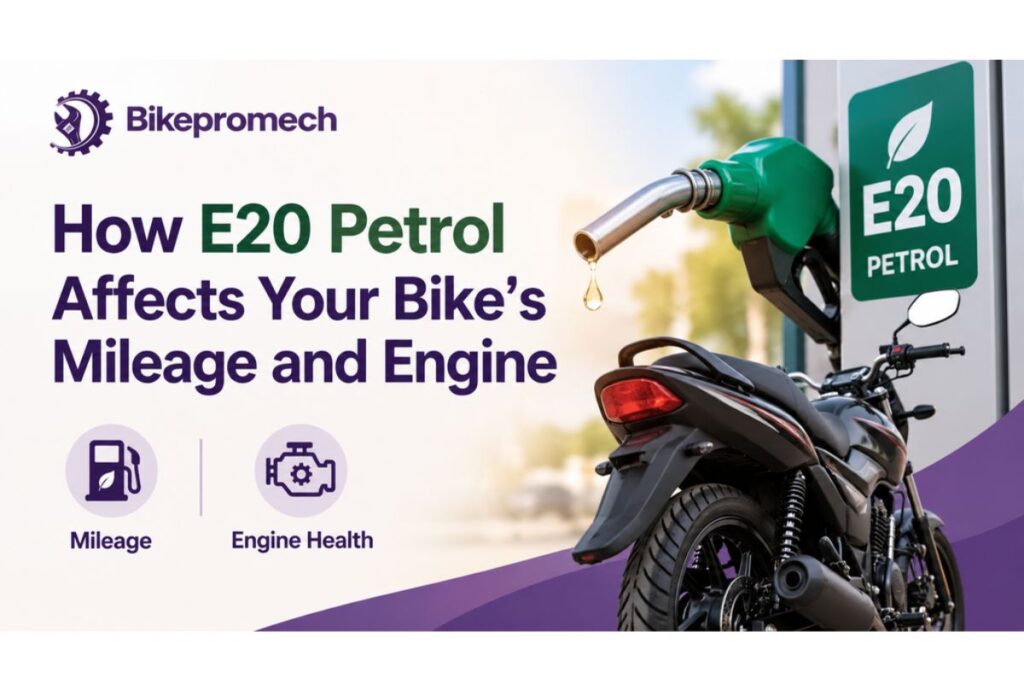
E20 petrol, a blend of 20% ethanol and 80% petrol, typically lowers bike mileage by about 1–2% on E20-compatible models and by roughly 3–6% on older bikes built for E10 fuel, according to figures the government has put before Parliament. On engines, the government says it has found no verified evidence of widespread damage, but older carbureted bikes with rubber fuel lines, petcock gaskets, and steel tanks carry the most risk, particularly when parked for weeks.
This guide explains why ethanol changes mileage, which bikes are affected most, what to inspect on an older bike, and what the extra fuel actually costs you per month. As of October 2026, E20 is the standard petrol at most Indian pumps, so this applies to nearly every rider.
What Is E20 Petrol?
E20 is petrol blended with 20% ethanol, an alcohol made mainly from sugarcane and grain. India’s ethanol blending rose from about 1.5% in 2013–14 to 20% over the November 2025–June 2026 period, reflecting a phased rollout. Earlier standard fuel was E10 (10% ethanol), and many bikes on the road today were originally designed and calibrated for E10 or even lower blends.
How Much Does E20 Reduce Bike Mileage?
The government’s own numbers vary by vehicle age and type:
| Source | Reported Mileage Impact | Applies To |
| Petroleum Ministry (July 2026) | 3–5% | Some vehicles designed for E10 |
| Minister of Road Transport (Lok Sabha reply, July 2026) | 2–6% | BS-III, BS-IV, and BS-VI two-wheelers and cars tested, depending on vehicle category and age |
| Media analysis of E20-compatible vehicles | Around 1–2% | Vehicles calibrated for E20 |
Two points keep these figures in perspective. First, the government says mileage also depends on vehicle condition, riding habits, and traffic, so ethanol is rarely the only reason for a drop. Second, the ministry argues E20’s higher octane rating brings better acceleration and smoother pickup, and it cites roughly 30% lower carbon emissions than E10. Consumer groups and opposition parties have questioned the mileage trade-off and maintenance costs, so the debate is ongoing.
For the government’s Parliament statements, see this report on the E20 reply to Parliament.
Why Does Ethanol Lower Mileage?
Ethanol holds roughly a third less energy per litre than petrol. A back-of-envelope calculation shows the effect: moving from E10 to E20 adds another 10 percentage points of ethanol, which trims the energy in each litre by about 3–4%. That lines up closely with the 3–5% figure the ministry quotes for older E10-designed bikes.
Newer bikes recover much of that loss. Fuel-injected engines with E20-ready calibration adjust the air-fuel mixture automatically, and the higher octane lets the engine run efficiently. That is why E20-compatible models show a smaller drop than older ones.
What Does the Mileage Loss Cost You Each Month?
Here is an illustrative calculation for a bike that returns 50 km/l, ridden 1,000 km a month, with petrol at ₹95 per litre:
| Mileage Drop | New Mileage | Extra Petrol per Month | Extra Cost per Month |
| 2% | 49 km/l | about 0.4 L | about ₹39 |
| 5% | 47.5 km/l | about 1.05 L | about ₹100 |
| 6% | 47 km/l | about 1.3 L | about ₹121 |
An Outlook Money estimate puts the extra yearly fuel spend at about ₹1,236 for older two-wheelers and about ₹272 for E20-compatible ones, using petrol at ₹95.05 a litre. Your own number depends on your bike, your distance, and local petrol prices.
Does E20 Damage Your Bike’s Engine?
The government’s position is that E20 does not damage engines. It told Parliament that more than 20 crore two-wheelers and over 3 crore petrol cars have run on E15-plus and E19–E20 blends without verified evidence of widespread engine failure, and that manufacturers continue to honour warranties on vehicles running the blend. Reports on the same reply also noted that a few older vehicles may need replacement gaskets, as covered in this Moneylife report on the government’s E20 response.
The mechanical concerns are real but narrower than the headlines suggest. They concentrate on older fuel systems, not on the engine’s internals:
- Rubber fuel lines, seals, and petcock gaskets: Older parts were designed for petrol, and ethanol can dry out, harden, or degrade some rubber compounds over time. Rider Magazine documented petcock and O-ring deterioration on an older bike left on ethanol blends.
- Carburetor components: Floats and gaskets in older carburetors are the usual trouble spots, and a rough or flooding carburetor often traces back to them.
- Water absorption: Ethanol attracts moisture. When a bike sits for weeks, water can separate out of the fuel and settle at the bottom of the tank and carburetor bowl.
- Steel tank rust: Separated water can rust the inside of older steel tanks.
- Harder cold starts: Ethanol evaporates less readily than petrol, which makes cold starting harder on carbureted engines, especially on cold mornings.
Which Bikes Are Most Affected by E20?
| Bike Type | Risk Level | What to Watch |
| Older carbureted bikes and scooters (built for E10 or lower) | Highest | Rubber lines, petcock gasket, carburetor floats, tank rust, cold starts |
| Fuel-injected BS6 bikes not labelled E20-ready | Moderate | Small mileage drop, fuel line and seal condition over time |
| E20-compatible bikes | Lowest | Roughly 1–2% mileage drop |
| Bikes parked for weeks at a time | Elevated, regardless of age | Water separation, stale fuel, hard starting |
Check your owner’s manual or ask the manufacturer’s dealer to confirm your model’s E20 status. Your registration certificate also shows the manufacture date, which helps place your bike’s vintage. If you’re unsure what that document contains, read our explainer on what a two-wheeler RC book is. Fuel-injected engines also depend on a clean throttle body to meter air correctly, which we cover in why a throttle body is used in a motorcycle engine.
8 Ways to Protect Your Bike’s Mileage and Engine on E20
- Keep tyres at the specified pressure. Underinflated tyres waste more fuel than most riders realise. Our guide on how to increase scooty mileage in city traffic covers this in detail for stop-and-go riding.
- Clean or replace the air filter on schedule. A clogged filter upsets the air-fuel ratio, and E20 already shifts that balance slightly.
- Replace old rubber fuel lines and petcock gaskets on older bikes. Do this at the first sign of cracking, hardening, or seepage, since these parts are cheap compared with the damage a leak causes.
- Get the carburetor cleaned and tuned. On carbureted bikes, a proper tune compensates for the leaner effect of ethanol blends.
- Don’t let fuel sit. If the bike will be parked for more than two or three weeks, ride it briefly each week and avoid leaving a nearly empty tank, since extra air space means more moisture.
- Use the correct engine oil and change it on time. Check how to know if your bike needs an oil change and our guide to the best engine oil for bikes. For a model-specific schedule, see the Royal Enfield Classic 350 engine oil change interval.
- Inspect the spark plug regularly. A weak spark worsens any mileage loss, and plug condition is part of a thorough service.
- Run through a full checklist at each service. Our quick bike service checklist lists the 25 checks that catch fuel-system and ignition issues early.
E20 Problems vs. Other Causes: A Quick Diagnosis Guide
Not every symptom after switching to E20 is the fuel’s fault. Use this table before blaming ethanol:
| Symptom | Possible E20 Link | Other Common Causes |
| Mileage dropped 2–5% | Likely, expected range | Tyre pressure, dirty air filter, riding style |
| Mileage dropped more than 10% | Unlikely to be E20 alone | Clogged filter, worn spark plug, brake drag, carburetor fault |
| Hard starting on cold mornings | Possible on carbureted bikes | Weak battery, fouled spark plug |
| Starting problems after weeks of parking | Possible: water separation, stale fuel | Dead battery, clogged carburetor jets |
| Fuel smell or visible seepage near the tank | Possible: degraded petcock gasket or fuel line | Loose fittings, damaged hose |
| Rough idle or stalling | Possible on older carbureted bikes | Dirty carburetor, spark plug, air leak |
If starting is the main problem, work through bike not starting: common causes and fixes and how to check bike battery health, because a weak battery mimics a fuel problem more often than riders expect.
What Does Fixing an E20-Related Fuel System Problem Cost?
Small jobs such as replacing a fuel line, petcock gasket, or cleaning a carburetor usually sit at the lower end of repair pricing, while ignored water damage and rust can push a job into engine-repair territory. For a full price breakdown by issue, see our guide to bike engine repair cost in India. Scooter owners can find service pricing for a popular model in our Honda Activa 6G/125 service cost 2026 guide, and riders unsure what routine work includes can read what a basic two-wheeler service includes.
Where to Get an E20 Check-Up: Garage, Authorized Center, or Doorstep?
Warranty-covered bikes belong at the manufacturer’s network when a fuel-system fault is suspected. For out-of-warranty bikes, a fuel line check, carburetor clean, and spark plug inspection are routine jobs any competent mechanic handles. Our comparison of local mechanic vs authorized service center for bikes helps you decide, and if you want the work done where your bike is parked, see the advantages of bike repair at home, how doorstep bike service works, and whether doorstep bike service is safe.
Has the Government Decided on Higher Blends Like E25?
As of the Petroleum Ministry’s July 2026 statements, the Centre had ruled out an immediate rollout of E25 and said no decision had been taken. Because policy can change, check current announcements and your manufacturer’s guidance before assuming your bike is ready for anything beyond E20.
Trusted Parts and Honest Diagnosis
Fuel-system repairs only last if the replacement parts are right. Ethanol-tolerant fuel lines and gaskets matter on older bikes, so ask which parts are being fitted and get the estimate before any work starts. At BikeProMech, every part replacement is quoted and approved by you before it is carried out, and genuine parts are confirmed before fitting. Where the cause turns out to be a worn battery, a tyre issue, or a breakdown, we route you straight to the right service: bike batteries, engine repair, periodic service, or roadside assistance, with the full list on our services page.
Get Your Bike Checked for E20 Wear at Your Doorstep
If your mileage has slipped, your older bike is slow to start, or you spot fuel seepage near the tank, a mechanic can inspect the fuel line, petcock, spark plug, air filter, and tyre pressure in one visit. Book a BikeProMech doorstep visit for a ₹199 visit charge, with the estimate shared and approved before any part is replaced.
BikeProMech serves riders across India. Find your city:
- Doorstep bike service in Bangalore and bike service at home in Bangalore
- Online bike service in Hyderabad
- Best bike service in Coimbatore
- Doorstep bike service in Pune
- Best bike service in Gurgaon
- Best bike service in Chennai
Riders replacing a bike or reviewing cover can also read our guides to the best-selling two-wheelers in India, the best bike insurance plans in India, and the top bike insurance companies in India.
Frequently Asked Questions
The government says it has found no verified evidence of widespread engine damage from E20, based on testing and the experience of more than 20 crore two-wheelers on E15-plus blends. The risk is concentrated in older fuel systems with rubber lines, gaskets, and carburetors that were not designed for ethanol.
Expect roughly 1–2% on E20-compatible bikes and about 3–6% on older bikes built for E10, with the exact figure depending on engine type, condition, and riding style. A drop above 10% usually points to a maintenance issue rather than ethanol alone.
Most pumps now sell E20, and reports note that unblended petrol is priced significantly higher and is not easily available to ordinary riders. Premium grades may be available at some outlets, but check the blend at the pump.
Reports on the government’s Parliament reply state that manufacturers continue to honour warranty obligations on vehicles running the blend. Keep your service records and confirm terms with your dealer if a claim is in question.
Ethanol absorbs moisture, and over time water can separate from the fuel and settle in the tank and carburetor, while stale fuel clogs jets. Draining old fuel, cleaning the carburetor, and checking the battery usually fixes it.
There is no official change to oil intervals because of E20 in the sources reviewed for this guide, so follow your manufacturer’s schedule and your riding conditions. Our oil change guides above explain how to judge when yours is due.
Inspect rubber fuel lines, the petcock gasket, and carburetor seals first, and replace anything that looks cracked, hardened, or seeping. These are inexpensive parts, and catching them early avoids tank rust and fuel leaks.