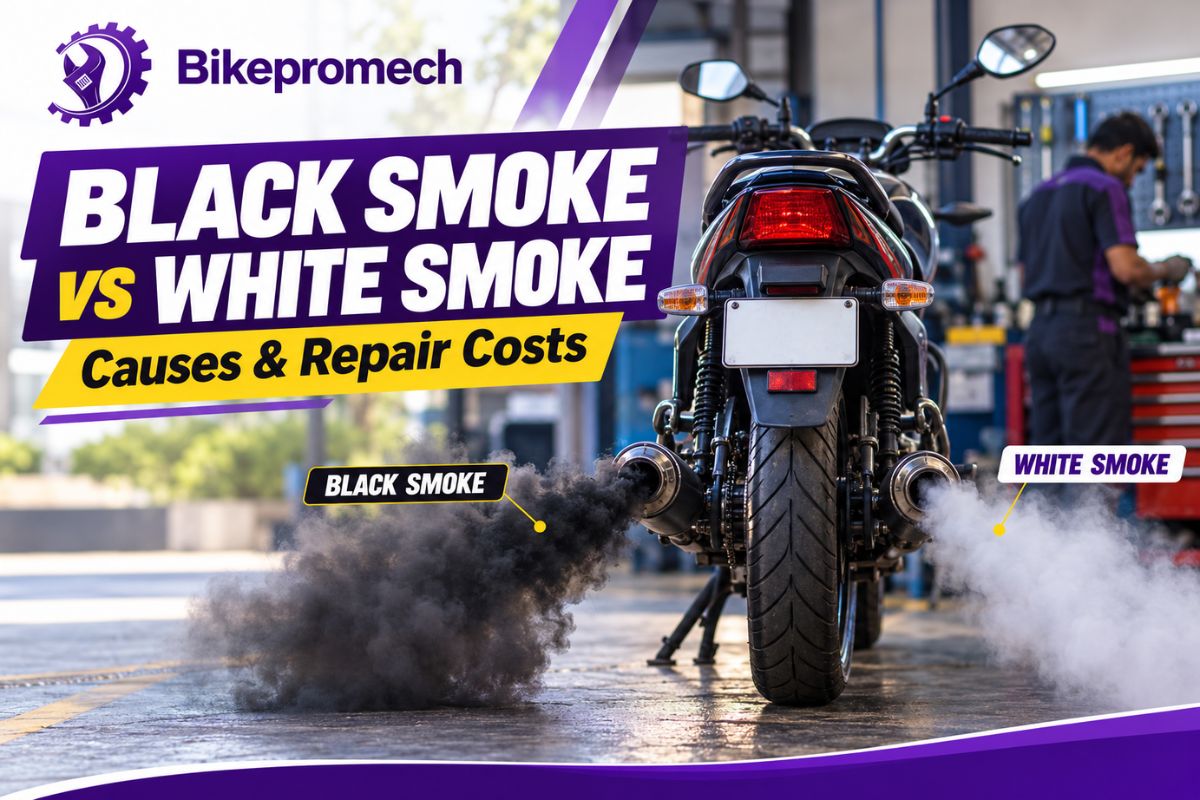


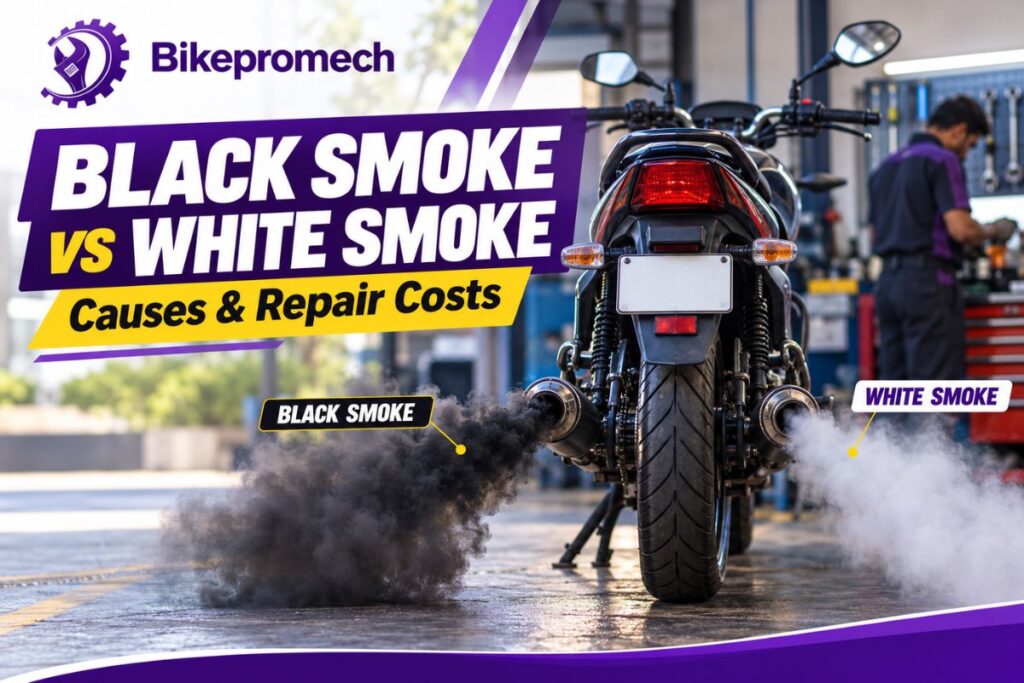
Black Smoke vs. White Smoke from Bike Exhaust. Black smoke from a bike exhaust means the engine is burning too much fuel (a “rich” air-fuel mixture), usually because of a clogged air filter, a dirty carburettor or throttle body, or a faulty fuel injector. White smoke means water or coolant is burning — thin white vapour on a cold morning is normal condensation, but thick white smoke that stays after the engine warms up points to a coolant leak or oil burning inside the engine. Most black smoke problems cost ₹150–₹1,500 to fix, while persistent white or blue-grey smoke can cost ₹1,500–₹25,000 if internal engine parts are worn.
Bike Exhaust Smoke Colour Chart: What Each Colour Means
| Smoke Colour | What Is Burning | Most Likely Causes | Severity | Approx. Repair Cost (India) |
| Black | Excess fuel | Clogged air filter, dirty carburettor/throttle body, leaking injector, choke left on | Low to medium | ₹150–₹1,500 (sensor fault: up to ₹4,000) |
| Thin white (disappears in 2–5 minutes) | Water vapour (condensation) | Cold weather, short rides | Normal | ₹0 |
| Thick white (stays after warm-up) | Coolant or heavy oil | Head gasket leak (liquid-cooled bikes), cracked head, overfilled oil | High | ₹1,500–₹8,000 |
| Blue / grey | Engine oil | Worn piston rings, worn valve stem seals, scored cylinder | High | ₹1,500–₹25,000 |
| No visible smoke | Clean combustion | Healthy engine | Normal | — |
Note: Repair costs are approximate ranges for commuter and mid-segment bikes (100cc–400cc) at independent workshops in Indian metros in 2026. Premium and imported bikes cost more. Labour and parts prices vary by city and model.
What Causes Black Smoke from a Bike Exhaust?
Black smoke from a bike silencer is caused by a rich air-fuel mixture — the engine receives more petrol than it can burn completely, and the unburnt carbon leaves the exhaust as black soot. A bike emitting black smoke usually also shows poor mileage, a petrol smell, and black, sooty deposits inside the silencer tip.
1. Clogged or dirty air filter
A blocked air filter restricts airflow into the engine while fuel supply stays the same, making the mixture rich. This is the most common cause of black smoke in Indian city bikes because of dust exposure. An air filter should be cleaned every 3,000–5,000 km and replaced every 10,000–12,000 km on most commuter bikes, or sooner in dusty conditions.
2. Dirty or maladjusted carburettor
On carburettor bikes (most pre-2020 BS-IV commuters), a clogged jet, a stuck float, or an incorrect air-fuel screw setting sends extra fuel into the engine. Carburettor cleaning and tuning usually fixes this in under an hour.
3. Dirty throttle body or faulty fuel injector (BS-VI bikes)
On fuel-injected BS-VI bikes, a carbon-coated throttle body or a leaking injector disturbs the air-fuel ratio. Learn how this part controls airflow in why a throttle body is used in a motorcycle engine.
4. Faulty O2 (oxygen) sensor or engine sensor
Fuel-injected bikes use an O2 sensor and other sensors to adjust fuelling. A failed sensor can make the ECU inject too much fuel, often with the engine check light (MIL) turning on.
5. Choke left on
On carburettor bikes and scooters, riding with the choke partly engaged enriches the mixture and produces black smoke within minutes.
6. Fouled spark plug
A weak or carbon-fouled spark plug fails to burn all the fuel, leaving unburnt petrol in the exhaust. A fouled plug also causes hard starting — see bike not starting: common causes and fixes.
What Causes White Smoke from a Bike Exhaust?
White smoke from a bike exhaust is either harmless water vapour or a sign that coolant or oil is entering the combustion chamber. The test is simple: thin white vapour that disappears within 2–5 minutes of riding is condensation; thick, dense white smoke that continues after the engine is fully warm is a mechanical problem.
1. Condensation (normal)
On cold mornings or during the monsoon, moisture collects inside the engine and silencer overnight. It exits as thin white vapour and sometimes drips of water from the silencer. This needs no repair.
2. Coolant leak into the engine (liquid-cooled bikes)
On liquid-cooled bikes such as the KTM Duke 200/390, Yamaha R15 and Bajaj Pulsar NS200, a damaged head gasket or cracked cylinder head lets coolant enter the combustion chamber. Signs include thick white smoke with a sweet smell, a coolant level that keeps dropping, and engine overheating. Air-cooled commuters like the Hero Splendor and Honda Shine do not have coolant, so persistent white smoke on these bikes usually points to oil.
3. Engine oil overfilled
Filling engine oil above the MAX mark can push oil into the combustion area through the breather system, producing white-grey smoke. Draining to the correct level fixes it. Check the right quantity and grade in this guide to the best engine oil for bikes.
4. Wrong or degraded engine oil
Oil that is too thin, or has broken down after crossing its change interval, slips past worn seals more easily and burns. Read how to know if your bike needs an oil change.
What Does Blue or Grey Smoke from a Bike Mean?
Blue or grey smoke from a bike exhaust means engine oil is burning inside the combustion chamber. It often looks white from a distance, so riders frequently mistake it for white smoke. Blue smoke comes with a distinct burnt-oil smell and a falling oil level between services.
The main causes are:
- Worn piston rings — oil from the crankcase moves past the rings into the cylinder. Common on bikes above 40,000–50,000 km or bikes that ran long on old oil.
- Worn valve stem seals — oil leaks down the valve stems, typically showing as a puff of blue smoke at start-up or after idling.
- Scored or worn cylinder bore — damage from overheating or poor lubrication lets oil past the piston.
- Two-stroke engines (older bikes) — older two-stroke bikes like the Yamaha RX100 always produce some blue smoke because oil is mixed with fuel; excess smoke means the oil pump or mix ratio is off.
Detailed cost breakdowns for these internal repairs are in bike engine repair cost in India.
Black Smoke vs White Smoke: Side-by-Side Comparison
| Factor | Black Smoke | White Smoke (persistent) | Blue / Grey Smoke |
| Root cause | Too much fuel | Coolant or heavy oil burning | Engine oil burning |
| Smell | Raw petrol | Sweet (coolant) or burnt oil | Burnt oil |
| Mileage impact | Drops sharply (often 15–30%) | Moderate | Moderate |
| Oil level drop | No | Sometimes | Yes |
| Coolant level drop | No | Yes (liquid-cooled bikes) | No |
| Typical fix | Air filter, carb/throttle body clean, spark plug | Head gasket, oil level correction | Piston rings, valve seals, rebore |
| Safe to keep riding? | Short term, yes — fix within days | No — risk of overheating | Short term only — check oil daily |
| PUC test result | Usually fails on high CO | Often fails | Usually fails on high HC |
Bike Smoke Repair Cost in India (2026)
| Repair | Fixes | Approx. Cost (Commuter 100–160cc) | Approx. Cost (200–400cc) |
| Air filter cleaning | Black smoke | ₹100–₹250 | ₹200–₹400 |
| Air filter replacement | Black smoke | ₹150–₹500 | ₹400–₹1,500 |
| Spark plug replacement | Black smoke, misfire | ₹100–₹350 | ₹300–₹1,200 |
| Carburettor cleaning and tuning | Black smoke | ₹300–₹800 | ₹500–₹1,200 |
| Throttle body cleaning | Black smoke (BS-VI) | ₹400–₹900 | ₹600–₹1,500 |
| Fuel injector cleaning | Black smoke (BS-VI) | ₹500–₹1,200 | ₹800–₹2,000 |
| O2 sensor replacement | Black smoke, MIL light | ₹1,500–₹3,000 | ₹2,500–₹5,000 |
| Engine oil change | Overfill/degraded oil | ₹350–₹700 | ₹800–₹2,500 |
| Valve stem seal replacement | Blue smoke at start-up | ₹1,500–₹3,000 | ₹2,500–₹5,000 |
| Head gasket replacement | Thick white smoke (liquid-cooled) | — | ₹2,000–₹6,000 |
| Piston ring replacement | Blue smoke | ₹2,500–₹5,000 | ₹4,000–₹10,000 |
| Full engine overhaul / rebore | Heavy blue smoke | ₹6,000–₹12,000 | ₹12,000–₹25,000+ |
For a branded scooter benchmark, compare these figures with the Honda Activa 6G and 125 service cost in 2026.
Also read – PUC Certificate for Two-Wheelers
How to Diagnose Bike Exhaust Smoke at Home (5-Step Check)
- Start the bike cold and watch for 5 minutes. If thin white vapour disappears as the engine warms, it is condensation — no repair needed.
- Hold a white tissue near the silencer for 10 seconds. Black soot means a rich mixture; oily spots mean oil burning; water droplets mean condensation or coolant.
- Check the engine oil level with the dipstick or sight glass. A level that drops between services confirms oil burning.
- Check the coolant reservoir on liquid-cooled bikes. A falling level with no visible leak suggests a head gasket problem.
- Pull and inspect the spark plug. Black, dry soot = rich mixture; black, wet oily deposit = oil burning; light tan/brown = healthy.
For a broader self-inspection, use this quick bike service checklist. On fuel-injected bikes, also check the battery, because low voltage can affect sensor readings — follow this DIY bike battery health check.
Will a Smoking Bike Fail the PUC Test?
Yes. A bike emitting black or blue smoke will usually fail the PUC emission test because black smoke raises carbon monoxide (CO) readings and blue smoke raises hydrocarbon (HC) readings above legal limits. Petrol two-wheelers must stay within the limits set under the Central Motor Vehicles Rules, and test results are recorded on the Parivahan PUC portal. Riding with excess visible smoke can also attract a challan under pollution norms set by the Ministry of Road Transport and Highways. Fix the smoke problem first, then take the PUC test. A failed or expired PUC can also complicate claims — compare the best bike insurance plans in India and bike insurance companies in India, and keep your two-wheeler RC book and PUC updated together.
How to Prevent Exhaust Smoke on Your Bike
- Change engine oil on schedule — every 2,500–3,000 km for mineral oil and 5,000–7,000 km for synthetic oil on most commuter bikes. Royal Enfield owners can follow the Classic 350 engine oil change interval.
- Clean the air filter every 3,000–5,000 km in dusty cities.
- Service the bike every 3,000–4,000 km or 3–4 months — see what a basic two-wheeler service includes.
- Avoid riding with the choke on after the engine warms up.
- Fill fuel from reliable pumps to avoid adulterated petrol that burns poorly.
- Do not ignore early symptoms — falling mileage, rough idle or a petrol smell often appear weeks before visible smoke. Scooter riders can also use these tips on how to increase scooty mileage in city traffic.
- Watch for related wear on high-mileage bikes — engines that start burning oil often have other worn parts. Check the signs your bike clutch plate is worn out during the same inspection.
Local Mechanic or Authorised Service Centre for Smoke Problems?
Black smoke problems (air filter, carburettor, spark plug) can be fixed reliably by any skilled mechanic. Blue or thick white smoke that needs engine opening is best handled by a workshop with proper tools and genuine parts. The trade-offs in cost, parts and warranty are explained in local mechanic vs authorised service center for bikes. Popular models from the list of best-selling two-wheelers in India have parts readily available at both.
Bike Smoking from the Exhaust? Get It Diagnosed at Home with BikeProMech
You do not need to ride a smoking bike across the city to a workshop. A BikeProMech mechanic comes to your home or office, identifies the smoke colour and cause on the spot, and fixes most black smoke issues in a single visit:
- Air filter cleaning or replacement
- Carburettor cleaning and tuning or throttle body cleaning for BS-VI bikes
- Spark plug inspection and replacement
- Engine oil change with the correct grade and quantity
- Oil level, coolant level and compression checks to diagnose white and blue smoke
- Clear upfront estimate before any major engine work
See exactly how BikeProMech’s doorstep bike service works, step by step. New to home service? Read is doorstep bike service safe — what you should know and the advantages of bike repair at home.
BikeProMech is available in:
- Doorstep bike service in Bangalore and bike service at home in Bangalore
- Online bike service in Hyderabad
- Doorstep bike service in Pune
- Best bike service in Chennai
- Best bike service in Gurgaon
- Best bike service in Coimbatore
Black, white or blue smoke — don’t wait for it to get worse. Book a BikeProMech doorstep inspection today and get a clear diagnosis and quote before you spend on repairs. Book your doorstep bike service now →
Frequently Asked Questions
Black smoke is not immediately dangerous to the engine, but it wastes fuel, fouls the spark plug, builds carbon in the silencer and will fail a PUC test. Fix it within a few days.
Thin white smoke that disappears within 2–5 minutes of starting, especially on cold mornings, is normal condensation. Thick white smoke that continues after the engine warms up is not normal and needs inspection.
White smoke is water vapour or coolant; blue or grey smoke is burning engine oil. Blue smoke has a burnt-oil smell and the oil level drops between services.
A short puff of blue smoke only at start-up usually means worn valve stem seals, which let oil seep into the cylinder while the bike is parked. A thin white puff at start-up is usually condensation.
Most black smoke fixes — air filter, spark plug, carburettor or throttle body cleaning — cost ₹150–₹1,500 on commuter bikes. An O2 sensor replacement can cost ₹1,500–₹5,000.
Valve stem seals cost about ₹1,500–₹5,000, piston rings ₹2,500–₹10,000, and a full engine overhaul ₹6,000–₹25,000 or more, depending on the bike.
Yes. Overfilled engine oil, or thin and degraded oil past its change interval, can burn and produce white-grey smoke.
If it is thin condensation that disappears, yes. If thick white smoke continues on a liquid-cooled bike, stop riding a coolant leak can overheat and seize the engine.