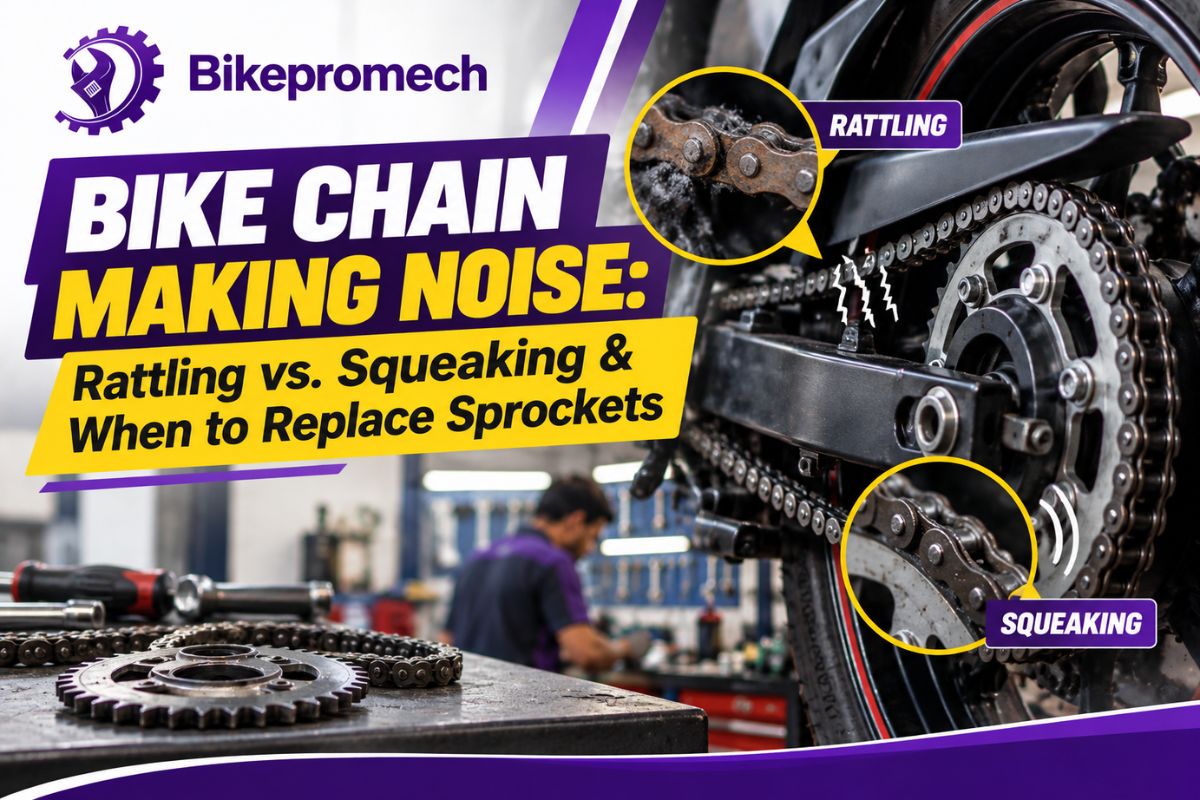


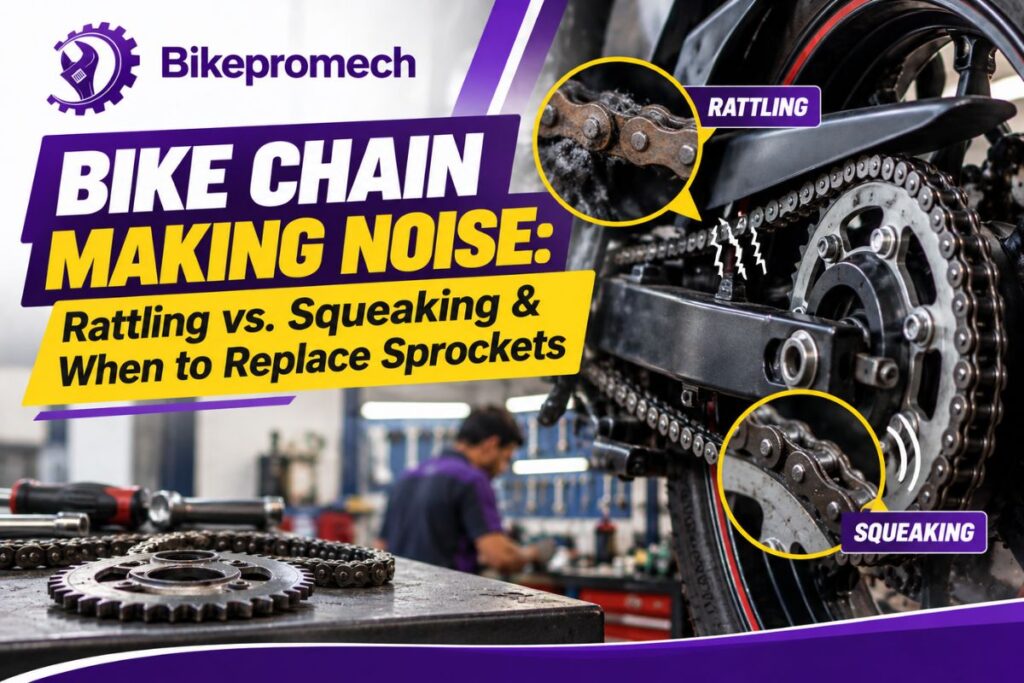
Bike Chain Making Noise: A rattling or slapping bike chain usually means the chain is too loose or stretched, while a squeaking chain means it is dry, rusted or over-tightened. Most chain noise is fixed with cleaning, lubrication and a slack adjustment costing ₹50–₹500; if the noise returns within days, the sprocket teeth look hooked, or the chain has run more than 15,000–25,000 km, replace the chain and both sprockets together as a kit (₹900–₹3,500 for most commuter and 150–200cc bikes).
Bike Chain Noise Chart: What Each Sound Means
| Noise | When You Hear It | Most Likely Cause | Fix | Approx. Cost (India) |
| Rattling / slapping | Over bumps, on deceleration, at low speed | Chain too loose (excess slack) | Chain adjustment | ₹50–₹150 |
| Rattling that returns after adjustment | Every few hundred km | Stretched chain, worn sprockets | Chain sprocket kit replacement | ₹900–₹3,500 (commuter to 200cc) |
| Squeaking / chirping | Constant, rises with speed | Dry chain, no lubrication | Clean and lubricate | ₹0–₹300 |
| Squeaking after rain or washing | First few km after getting wet | Water washed lube away, surface rust | Dry, clean, re-lube | ₹0–₹300 |
| Whining / humming | At steady speed | Over-tightened chain or misalignment | Readjust slack and alignment | ₹50–₹200 |
| Grinding / crunching | Under acceleration | Worn sprocket teeth, dirt and grit, misaligned wheel | Clean, align; replace kit if worn | ₹200–₹3,500 |
| Clunk on acceleration or gear change | Pulling away, shifting | Tight spots in chain, worn sprocket, or clutch/transmission issue | Inspect chain; check clutch | Varies |
Note: Costs are approximate 2026 ranges for independent workshops in Indian metros. Premium bikes (KTM, Royal Enfield 650, Triumph, Kawasaki) cost more. Labour and parts vary by city and brand.
Why Is My Bike Chain Rattling?
A bike chain rattles when it has too much slack and slaps against the chain guard, swingarm or sprocket teeth. Rattling is the most common chain noise on Indian commuter bikes because city riding, potholes and stop-start traffic stretch chains faster than highway riding.
1. Chain too loose (excess slack)
Every bike has a specified chain slack — the up-and-down free play measured at the midpoint of the lower chain run. Most commuter and mid-size bikes in India specify 20–35 mm; always check your owner’s manual for the exact figure (for example, on the Hero MotoCorp or Honda Motorcycle & Scooter India websites). Slack above the limit causes rattling and can let the chain jump teeth.
2. Stretched (worn) chain
Chains don’t actually stretch — the pins and bushings wear, increasing the length between links. A worn chain needs adjustment more and more often. If you have used up all the adjuster range on the swingarm, the chain is finished.
3. Worn sprockets
Worn sprocket teeth no longer hold the chain rollers tightly, so the chain lifts and rattles even when slack is correct.
4. Chain guard or chain slider contact
A bent chain guard or a worn rubber chain slider on the swingarm lets the chain hit metal, creating a rattling or tapping sound.
5. Damaged or stiff links
A link with a seized pin creates a “tight spot” — the chain is tight in one position and loose in another, causing periodic rattling or jerks.
Why Is My Bike Chain Squeaking?
A bike chain squeaks when metal rollers and sprocket teeth rub without lubrication. Squeaking is the chain asking for lubricant, and it is most common after rain, a pressure wash, or a long ride on dusty roads.
1. Dry chain
Most commuter bike chains need lubrication every 500–700 km, and immediately after riding in rain or washing the bike. A dry chain squeaks, wears up to several times faster, and reduces mileage because of increased friction.
2. Rust on the chain
Bikes parked outside during the monsoon develop surface rust on rollers and plates. Rust causes squeaking, stiff links and rapid wear.
3. Over-tightened chain
A chain with less slack than specified creates a whining or squeaking sound and puts heavy load on the gearbox output shaft bearing and rear wheel bearing.
4. Wheel misalignment
If the rear wheel is not aligned after adjustment, the chain runs at an angle and rubs against the side of the sprocket teeth, producing squeaking and uneven wear on one side of the sprocket.
5. Wrong lubricant
Using engine oil or diesel on the chain attracts dust and grit that grind the chain, while thick grease does not penetrate the rollers. Use a dedicated chain spray or chain lube. Engine oil belongs in the engine — see the best engine oil for bikes and how to know if your bike needs an oil change.
Rattling vs Squeaking Chain: Side-by-Side Comparison
| Factor | Rattling Chain | Squeaking Chain |
| Main cause | Too loose or worn | Too dry, rusted, or too tight |
| Sound type | Slapping, clattering, knocking | High-pitched squeak or chirp |
| Worse when | Going over bumps, closing throttle | Riding at steady speed, after rain |
| Quick fix | Adjust slack | Clean and lubricate |
| Long-term risk | Chain jumping teeth, broken chain | Rapid chain and sprocket wear |
| Usually means replacement? | Often, if it keeps returning | Rarely, unless heavily rusted |
How to Check Chain Slack (5-Minute DIY Test)
- Put the bike on its main stand in neutral with the engine off.
- Find the midpoint of the lower chain run between the front and rear sprockets.
- Push the chain up and pull it down with your finger and measure the total movement with a ruler.
- Rotate the rear wheel and repeat at 3–4 points. If slack varies a lot between points, the chain has tight spots and is worn unevenly.
- Compare with your owner’s manual — typically 20–35 mm for most commuter and mid-size bikes.
If slack is out of range, adjust using the rear axle adjusters, keeping both sides equal using the alignment marks on the swingarm. Over-tightening is worse than slight looseness.
Also read – Black Smoke vs. White Smoke from Bike Exhaust
When Should You Replace Bike Sprockets?
Replace the front and rear sprockets when the teeth become hooked, pointed or uneven, when the chain lifts off the rear sprocket easily, or every time you replace the chain. A new chain on old sprockets wears out within a few thousand kilometres and makes the same noise again.
Signs your bike sprockets are worn out
- Hooked or “shark-fin” teeth — the teeth lean in the direction of rotation instead of being symmetrical.
- Pointed or thin tooth tips — teeth look sharp instead of flat-topped.
- Broken or chipped teeth — any missing tooth means immediate replacement.
- Chain lifts off the rear sprocket — pull the chain away from the rear sprocket at the 3 o’clock position. If you can see more than half a tooth, the chain and sprocket are worn.
- Uneven wear on one side of the teeth — indicates wheel misalignment.
- Noise returns quickly after adjustment — needing adjustment every few hundred kilometres means the drive set is finished.
- Jerky pickup or a “clunk” when accelerating — worn sprockets let the chain skip slightly under load.
Why chain and sprockets must be replaced together
A chain and sprockets wear into each other as a matched set. Fitting a new chain on worn sprockets (or new sprockets with an old chain) causes poor meshing, noise and fast wear of the new part. Always replace the chain, front sprocket and rear sprocket together as a chain sprocket kit.
How Long Does a Bike Chain and Sprocket Kit Last?
| Bike Type | Typical Chain Kit Life | Notes |
| 100–125cc commuter (standard chain) | 15,000–20,000 km | Shorter with poor lubrication or heavy city use |
| 150–200cc (standard or O-ring) | 18,000–25,000 km | O-ring chains last longer |
| 250–400cc (O-ring / X-ring) | 25,000–35,000 km | With regular cleaning and lube |
| Neglected chain (rarely lubricated) | 8,000–12,000 km | Rust and grit cut life sharply |
Chain Sprocket Kit Replacement Cost in India (2026)
| Bike Category | Example Models | Chain Sprocket Kit (Parts) | Labour | Total Approx. |
| 100–110cc commuter | Hero Splendor, HF Deluxe, Honda Shine 100, TVS Sport | ₹800–₹1,500 | ₹200–₹400 | ₹1,000–₹1,900 |
| 125cc commuter | Honda Shine, Hero Glamour, Bajaj Pulsar 125 | ₹1,000–₹1,800 | ₹200–₹400 | ₹1,200–₹2,200 |
| 150–200cc | Pulsar 150/NS200, Apache RTR 160, Yamaha FZ, R15 | ₹1,500–₹3,200 | ₹300–₹500 | ₹1,800–₹3,700 |
| 350cc | Royal Enfield Classic 350, Hunter 350, Bullet 350 | ₹2,500–₹4,500 | ₹400–₹600 | ₹2,900–₹5,100 |
| 390cc and above | KTM 390 Duke, Interceptor 650, Dominar 400 | ₹4,000–₹9,000 | ₹500–₹800 | ₹4,500–₹9,800 |
| Smaller Chain Jobs | Approx. Cost |
| Chain cleaning and lubrication | ₹100–₹300 |
| Chain slack adjustment and wheel alignment | ₹50–₹200 |
| Chain lube spray (150–500 ml can) | ₹250–₹700 |
| Chain slider / chain guard replacement | ₹150–₹800 |
For full service benchmarks, see what a basic two-wheeler service includes and the bike engine repair cost in India guide. Royal Enfield owners can pair chain care with the Classic 350 engine oil change interval.
Do scooters have a chain?
Most gearless scooters like the Honda Activa, TVS Jupiter and Suzuki Access use a CVT belt drive, not an exposed chain, so they don’t need chain lubrication or sprocket replacement. Noise from a scooter’s rear usually comes from the CVT belt, rollers or clutch. See the Honda Activa 6G and 125 service cost in 2026 for scooter service benchmarks, and these tips on how to increase scooty mileage in city traffic.
How to Clean and Lubricate a Bike Chain (Step-by-Step)
- Put the bike on its main stand in neutral with the engine off. Never run the engine while cleaning the chain.
- Spray chain cleaner (or kerosene on a cloth for standard non-O-ring chains) along the chain while rotating the rear wheel by hand.
- Scrub with a chain brush to remove grit from the rollers and side plates.
- Wipe the chain dry with a clean cloth.
- Spray chain lube on the inner side of the lower chain run (where the chain meets the sprocket) while rotating the wheel slowly.
- Wait 10–15 minutes before riding so the lube penetrates and sets.
- Wipe off excess lube from the outside to reduce dust buildup.
Repeat every 500–700 km, after every rain ride, and after every wash.
Can You Ride with a Noisy Chain?
You can ride a short distance with a squeaking chain, but a rattling chain with excess slack should be fixed immediately. A loose or worn chain can jump off the sprocket, jam the rear wheel and cause a crash, or break and damage the engine casing. A chain that snaps at speed is one of the most dangerous mechanical failures on a two-wheeler.
Chain noise can also be confused with other drivetrain sounds. A clunk or slip while changing gears may be a clutch problem — check the signs your bike clutch plate is worn out. Rough running and jerky pickup can also come from fuelling issues; see why a throttle body is used in a motorcycle engine and bike not starting: common causes and fixes.
How to Prevent Chain Noise and Extend Sprocket Life
- Lubricate every 500–700 km and after every rain ride or wash.
- Check slack every 1,000 km — city potholes loosen chains faster.
- Keep the rear wheel aligned using the swingarm marks after every adjustment.
- Avoid pressure-washing the chain directly — it forces water past O-rings and washes out lube.
- Avoid wheelies, hard launches and aggressive downshifts that shock-load the chain.
- Replace chain and sprockets as a set — never mix old and new parts.
- Follow a regular service checklist — use this quick bike service checklist to cover chain, brakes, tyres and battery together. For electrical checks, use the DIY bike battery health check guide.
Local Mechanic or Authorised Service Centre for Chain Replacement?
Chain cleaning, adjustment and chain sprocket kit replacement are routine jobs that any skilled mechanic can do, provided genuine or reputed-brand kits are used. Authorised centres charge more but guarantee OEM parts. Compare cost, parts quality and convenience in local mechanic vs authorised service center for bikes. Chain kits for the best-selling two-wheelers in India are widely available at both.
Keep your paperwork in order while servicing: a valid two-wheeler RC book and insurance help if a chain failure ever leads to an accident claim. Compare the best bike insurance plans in India and bike insurance companies in India.
Noisy Chain? Get It Fixed at Your Doorstep with BikeProMech
A rattling or squeaking chain is a 30–60 minute job that you don’t need to ride to a workshop for. A BikeProMech mechanic comes to your home or office and handles:
- Chain cleaning and lubrication with proper chain cleaner and lube
- Chain slack adjustment and rear wheel alignment
- Chain and sprocket wear inspection with a clear replace-or-not recommendation
- Chain sprocket kit replacement using genuine or reputed-brand kits
- Chain slider and chain guard checks
- Upfront quote before any part is replaced
See exactly how BikeProMech’s doorstep bike service works, step by step. New to home service? Read is doorstep bike service safe — what you should know and the advantages of bike repair at home.
BikeProMech is available in:
- Doorstep bike service in Bangalore and bike service at home in Bangalore
- Online bike service in Hyderabad
- Doorstep bike service in Pune
- Best bike service in Chennai
- Best bike service in Gurgaon
- Best bike service in Coimbatore
Chain rattling or squeaking? Don’t wait for it to snap. Book a BikeProMech doorstep chain check today and get a clear diagnosis and quote on the spot. Book your doorstep bike service now →
Frequently Asked Questions
Washing removes chain lubricant, so the dry rollers squeak against the sprockets. Dry the chain and apply chain lube immediately after every wash.
Lubricate a bike chain every 500–700 km, and after every ride in rain or every wash.
Most commuter and mid-size bikes in India specify 20–35 mm of chain slack at the midpoint of the lower run. Check your owner’s manual for the exact figure.
It is not recommended. A new chain on worn sprockets wears out quickly and keeps making noise. Replace the chain, front sprocket and rear sprocket together as a kit.
A chain sprocket kit with labour costs about ₹1,000–₹2,200 for 100–125cc bikes, ₹1,800–₹3,700 for 150–200cc bikes, and ₹2,900–₹5,100 for Royal Enfield 350cc models.
Worn sprockets have hooked, pointed or chipped teeth. If you can pull the chain away from the rear sprocket and see more than half a tooth, the drive set needs replacement.
No. A loose chain can jump off the sprocket, lock the rear wheel or break. Adjust it before riding further.
Engine oil works only as a temporary emergency fix. It flings off quickly and attracts dust that grinds the chain. Use a dedicated chain lube.